
Does this sound familiar? You run an email acquisition campaign, the names land in your database, you have a really great plan to steward and engage with them – but the team gets busy and the project is forgotten.
So the list sits! And, eight months past the point that a subscriber would remember who you are, somebody says: “We should really email those people!”
What the action actually tells you
We are asked to support things all day long and say “no” to nearly all of it, so when somebody signs a petition or gives you their email address, they’re telling you something real about themselves. The real reason they chose to act is a personal value, and they’re showing you a version of themselves they feel good about.
Behavior, tastes, and styles change. But your values and sense of identity rarely do.
Where you shop has changed plenty of times, but if you’re a cat person, your identity as a person who cares about animals hasn’t shifted and likely never will. It’s a value you hold. When you take action to reinforce your values, you show the world who you truly are.
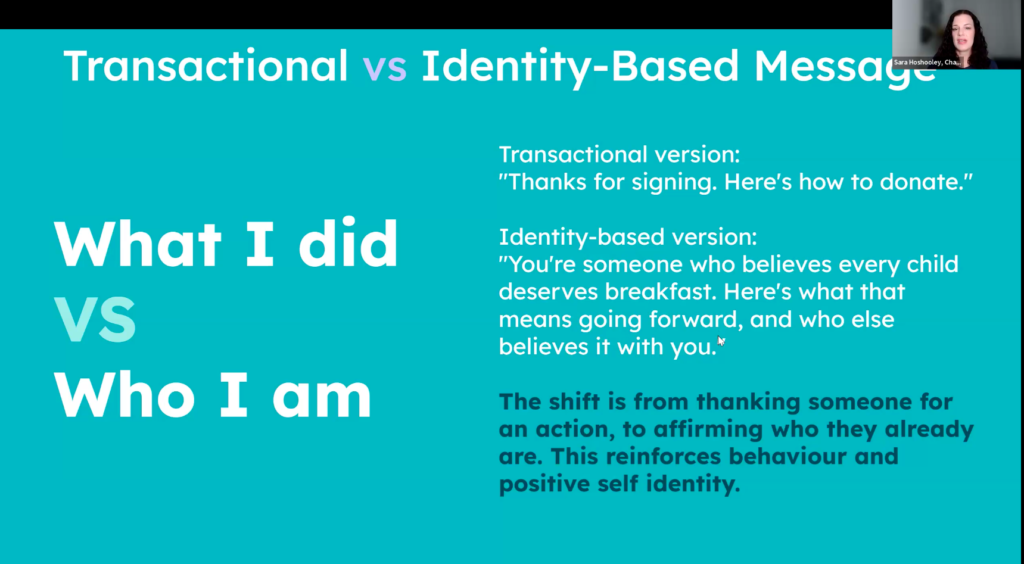
So, what does this look like in practice? Consider these two responses after signing a petition to fund community breakfast programs.
- “Thanks for signing our petition to fund breakfast programs in our city”.
- “Thank you for being the kind of person who believes every child deserves breakfast before school.”
Same message, same action – but one talks to you as someone who shares a particular value, and the other is a transactional thank you for your behavior.
Four emails, thirty days
Here’s what we recommend:
Email 1: The first email opens with gratitude, reflects the identity or value, reminds them what they did, and tells them what they’ll hear from you and how often. No ask! And, we don’t just mean no donation ask, we mean no ask at all.
Email 2: The second is about who else is part of this with them, and real numbers help: “2,981 people signed this petition, and 33 became donors this week.” That second number referencing donors is priming the subscriber without specifically asking them to donate. It makes donating feel more familiar when they are asked later on. As a call-to-action, you can try linking to a short supporter survey on your website and asking your members to fill it out. We’ve learned from experience that donors and advocates love to be asked to share their opinion!
Email 3: Third email is proof, meaning, one story tied to the thing they already told you they care about. This sets up the ask without making it.
Email 4: The final email is the ask – whether monthly or one time. Make sure it’s small, specific, and one click away. It should remind them of what they did first, because a month is plenty of time to forget. The majority of emails are read on mobile devices, so make sure that whatever your call-to-action is, it can be easily completed on a smartphone.
Say the same thing every single time
Decide what you’re asking for before you spend a dollar on acquisition. For example, on one campaign the ask was $5 a month.
The donate button went to a page built for that $5 campaign alone, with the same sentence at the top that had run through the petition and every email since, and $5 monthly already selected. Trust is the only currency we really have with donors, so if you asked for one thing, the page needs to be that exact thing you asked for – not a generic donation page.
The power of text messaging
Backing up fundraising or advocacy emails with SMS messages is a great way to reinforce your campaigns. We know that text messages have a 99% open rate and 6.8% click-through rate, so adding them to your email program has huge benefits for charities. M+R Research found that adding text messaging to an existing email program can increase the amount of revenue raised per person by 25% or more.
Text messaging is also a valuable stewardship activity, helping you thank your donors and keep supporters up-to-date with your initiatives. At Care2, we do a lot of experimenting with email and text messages to our members to understand what motivates people to respond.
We’ve learned that text messages with rich link previews featuring titles and images perform far better than plain text links as they are seen as more trustworthy by recipients. We’ve also learned that the photo used in your email or your text message should match the image on your call-to-action’s landing page. When there’s an image mismatch, supporters are far more likely to bounce and not complete the call to action.
One final thought
Ask for replies! Something as simple as “I’d love to know what made you take this action”, because people will write back and you’ll end up with content you couldn’t have written yourself. Replies also teach email service providers that your mail is wanted and legitimate which helps deliverability.
If someone says you’re emailing too much, go and look at the numbers. An unsubscribe rate under 1% per send is normal and unsubscribes are a gift anyway.
None of this needs a bigger program or a messaging overhaul. It’s four emails, the same sentence carried from the petition through to the donation page, and a decision made early about what you’re going to ask for. Someone raised their hand and told you who they are, so the whole job is to say it back to them clearly enough that giving feels like the next thing they’d naturally do.
Want to learn more about creating an effective email welcome series?
Watch our webinar Beyond the “thank you”: What your email subscribers need to become donors! with Sara Hoshooley. She explains how to create the right messages at the right time for your audience.
About the authors:
This article first appeared in the October 2026 issue of DMAW Direct Impact Magazine.
Sara Hoshooley of Charity Shift is a fundraising consultant and coach who loves helping organizations grow their fundraising through campaigns, strategy and customized coaching.
Claire Kerr is a nonprofit veteran who has worked for organizations in economic development and fundraising sectors. At Care2, she works with charities and nonprofits as they use digital channels to acquire new supporters, as well as advocate for progressive causes online.
Want to grow your email or SMS lists with new supporters? Care2 helps your organization find new friends who want to take action for your cause.
